


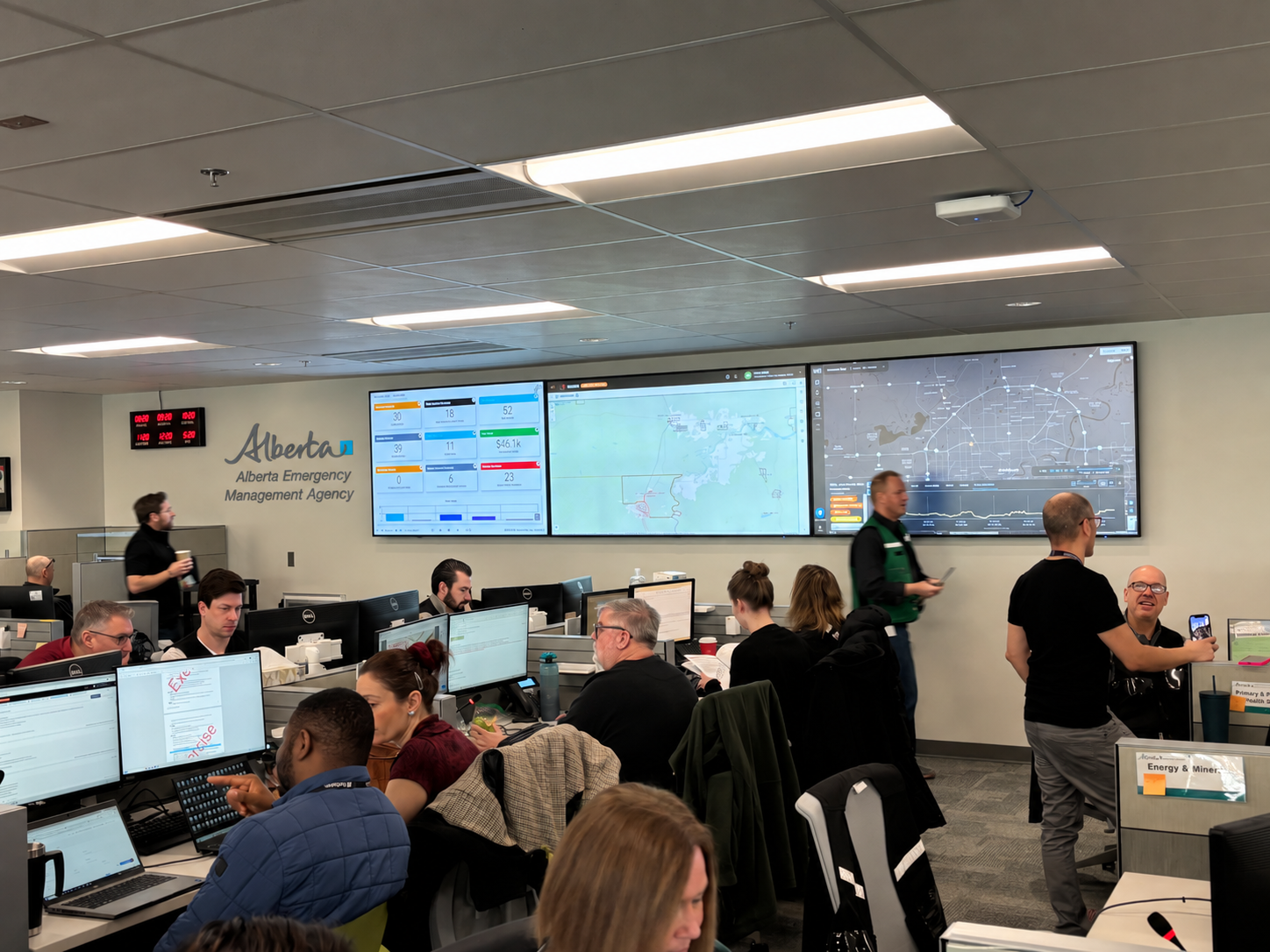
The Alberta Emergency Management Agency (AEMA) leads emergency and disaster prevention, preparedness, and response across the province, coordinating everything from wildfire suppression to emergency social services. AEMA protects roughly five million people across one of Canada’s largest, most hazard-prone provinces, where reaching an incident from Edmonton headquarters can mean a ten-hour drive. The agency runs a 24/7 Provincial Emergency Coordination Centre, and during hazard season (March to October), wildfires can displace 80,000 to 100,000 people at once, demanding real-time coordination across agencies.
When AEMA selected WebEOC as its new incident information management system, the timeline was anything but ordinary. Procurement delays compressed a planned full hazard-season rollout into a sprint: the contract was signed November 10, 2025, the kickoff meeting was November 20th, and the legacy system expired December 31st. Accounting for holidays and shutdown days, the team had just 19 business days to go live.
They made it. By December 23rd, duty officers were using WebEOC in production, with strongly positive feedback from day one.
The team’s approach was disciplined: rather than heavy customization, they committed to out-of-the-box functionality, focusing on the critical-path workflows covering most operations, including event reporting, the resource/incident display (RID) board, and the plan builder. This let them move fast without customization ripple effects.
Training followed suit. Leaders built internal guides on Juvare’s video resources, then had two trainers onboard nearly 300 staff across six sessions (March 2 to 18). By late March, AEMA ran its annual province-wide exercise entirely on WebEOC, drawing thank-yous rather than complaints from staff.
Today, AEMA is building master views for situational awareness, shelter registration for mass evacuations, and field-to-operations intelligence pipelines. Demand for training remains high, and other jurisdictions, including British Columbia and the Government of Canada, are reaching out to learn from Alberta’s approach. As the team put it: “The most exciting stuff is still to come.”